In an industrial compressed air system, the air receiver tank is often treated as “just storage,” while air dryers (refrigerated and desiccant) are seen as the only devices responsible for air quality. In reality, they work best as a system: a properly sized receiver stabilizes pressure and removes bulk condensate, while the dryer controls dew point and protects downstream equipment.
So—do you have to use an air receiver tank with an air dryer?
Not in every system, but in most industrial applications, it is strongly recommended. Skipping the tank can lead to unstable dryer performance, higher dew point, frequent alarms, and avoidable maintenance costs.
This guide explains what each component does, when a receiver is essential, and how to size, install, and maintain it correctly.
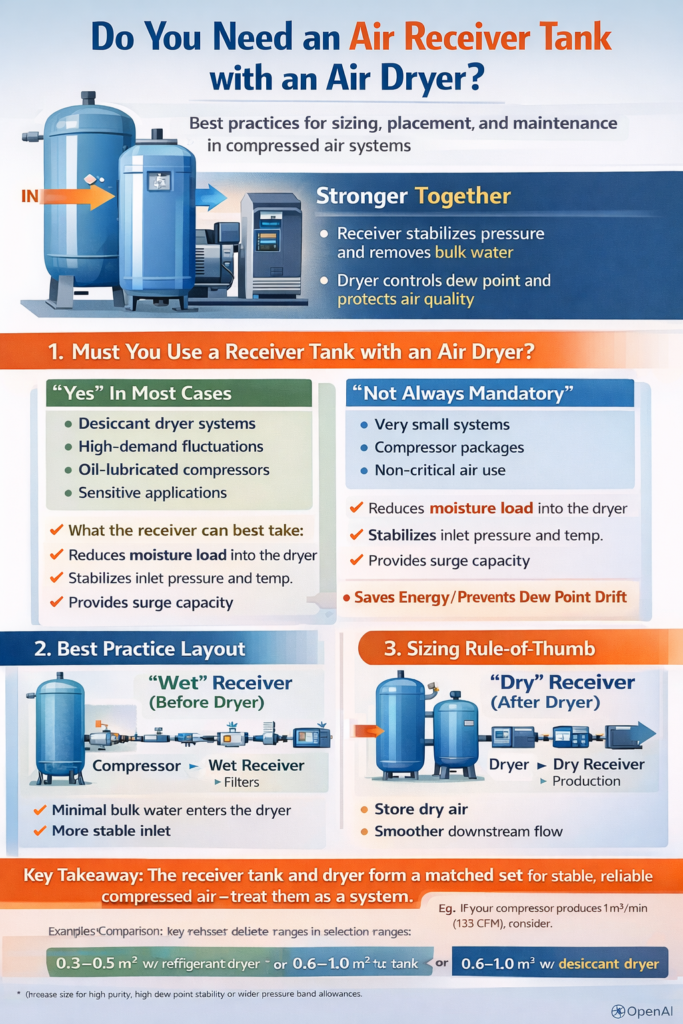
1) What an Air Receiver Tank Really Does
An air receiver is more than a “gas bottle.” It typically serves three key roles:
1. Pressure stabilization and surge capacity
Buffers demand spikes and reduces pressure fluctuations.
Provides short-term reserve air to keep production running during compressor cycling or brief downtime.
2. Moisture knock-out (pre-treatment)
As compressed air cools and slows inside the receiver, liquid water and some oil aerosol can drop out by gravity.
This reduces the moisture load going into the dryer and helps:
improve dryer stability,
extend filter element life,
reduce desiccant stress (for desiccant dryers),
improve overall air quality.
3. System efficiency improvement
A receiver reduces short cycling and helps the compressor and dryer operate closer to their designed conditions, which can improve reliability and operating cost.
2) What the Dryer Does (and Why Inlet Conditions Matter)
Air dryers remove water vapor to meet a target dew point:
Refrigerated air dryers typically deliver a pressure dew point around +3°C to +10°C (application-dependent).
(adsorption) Desiccant air dryers are used for much lower dew points, commonly –40°C and sometimes –70°C.
Dryer performance depends heavily on:
inlet temperature
inlet pressure
inlet moisture load
flow stability
When you feed the dryer “wild” air—high temperature, high liquid water carryover, and rapidly changing flow—problems appear fast.
3) Must They Be Used Together?
The practical answer
Not always mandatory, but for most industrial systems, a receiver tank is best practice and often the difference between stable dew point and constant troubleshooting.
When you can sometimes run without a receiver
Very small systems with stable, low demand and short piping.
Compressor packages that include effective separation and sufficient internal volume.
Applications where dew point is not critical and occasional moisture is acceptable.
Even in these cases, the lack of a receiver often increases the risk of:
higher moisture entering the dryer,
unstable inlet conditions,
faster wear on filters/valves/desiccant,
pressure swings that affect production quality.
When a receiver tank is strongly recommended (often “required” in practice)
Desiccant dryer systems (especially –40°C and below).
High-demand fluctuations: packaging, CNC, robots, paint lines, pneumatic conveying.
Hot/humid environments with high moisture load.
Oil-lubricated compressors where liquid carryover risk is higher.
Sensitive industries: electronics, pharma/food, medical, precision manufacturing.
4) Best Practice Layout: Where to Put the Receiver Tank
Many systems perform best with two tanks:
A) “Wet” receiver (before the dryer)
Purpose: stabilize flow and knock out bulk condensate before the dryer.
Typical placement:
Compressor → Aftercooler → Water separator + drain → Wet receiver → Filters → Dryer
Benefits:
less liquid water reaches the dryer,
lower moisture shock,
more stable inlet temperature and flow.
B) “Dry” receiver (after the dryer)
Purpose: store already-dried air and handle downstream demand spikes without disturbing dryer operation.
Typical placement:
Dryer → Dry receiver → Point-of-use filters → Production
Benefits:
steadier dew point under fluctuating demand,
reduced pressure drops during peak consumption,
improved system responsiveness.
5) How to Select the Right Receiver Tank (Matched to the Dryer)
5.1 Pressure rating
Choose a tank rated at or above the compressor’s maximum discharge pressure, and ensure it matches the pressure class of your dryer and filters. Underrated pressure equipment increases safety risk and can damage downstream components.
5.2 Volume sizing (simple rule-of-thumb)
A practical sizing rule used in many plants is:
Receiver volume ≈ compressor flow × 0.3–0.5 (in matching “m³” terms)
For desiccant dryer systems, many users increase this to 0.5–1.0× to improve stability and pre-separation.
Example
If compressor flow is 1 m³/min at 8 bar, a common selection approach is:
with a refrigerated dryer: 0.3–0.5 m³ receiver
with a desiccant dryer for critical dew point: 0.6–1.0 m³ receiver
Note: Final sizing depends on demand pattern, allowable pressure band, compressor control type, and dew point requirement. The rule above is a practical starting point.
5.3 Material selection
Carbon steel / low-alloy steel: common for general industry; ensure corrosion control and proper condensate management.
Stainless steel: preferred for high purity / corrosion-sensitive sectors (food, pharma, medical, microelectronics), to reduce contamination and corrosion risk.
6) Connections and Piping: Avoid Unnecessary Pressure Drop
Poor piping can erase the benefits of good equipment.
Threaded connections are common for smaller ports; ensure correct sealing to prevent leaks.
Flanged connections are preferred for larger diameters; they improve sealing and simplify maintenance.
Best practices:
Match tank/dryer port sizes to your actual flow (avoid undersized piping).
Minimize sharp elbows and restrictions near the dryer inlet.
Add isolation valves and a bypass where maintenance downtime is expensive.
7) Safety Devices and Compliance (Don’t Treat This as Optional)
An air receiver is a pressure vessel. At minimum, it should have:
a properly sized pressure relief valve
a pressure gauge
a reliable automatic drain (and manual backup where appropriate)
Inspection and registration requirements vary by country/region and by vessel size/pressure class. Always follow local pressure vessel codes and manufacturer guidance.
8) Operating & Maintenance Tips (Receiver + Dryer as One System)
To prevent recurring dryer problems and extend equipment life:
Drain condensate routinely
Standing water in the receiver can re-enter the system and overload the dryer.Prevent oil and liquid water carryover
Maintain separators, drains, and pre-filters—oil/water shock is a top reason for dryer failure and desiccant damage.Avoid over-temperature and poor cooling
High inlet temperature increases moisture load and reduces dryer capacity.Check for leaks regularly
Leaks reduce pressure, increase dryer cycling issues, and waste energy.Record key indicators
Log pressure stability, drain performance, and dew point trends. If dew point drifts or pressure swings increase, investigate early.
Conclusion
An air receiver tank and an air dryer do not “have” to be used together in every system—but for most industrial applications, they should be treated as a matched pair.
The receiver stabilizes pressure and removes bulk condensate (pre-treatment).
The dryer controls dew point and protects air quality (deep treatment).
When properly sized and installed—often with a wet receiver before the dryer and a dry receiver after—the system becomes more stable, more energy-efficient, and far less prone to dew point drift and equipment failures.