Nitrogen is one of the most widely used industrial gases, employed in applications ranging from food packaging and pharmaceuticals to metal fabrication and chemical processing. One key question often asked is: Is nitrogen flammable? Understanding nitrogen flammability is critical for workplace safety, storage, and handling, especially in industrial environments.
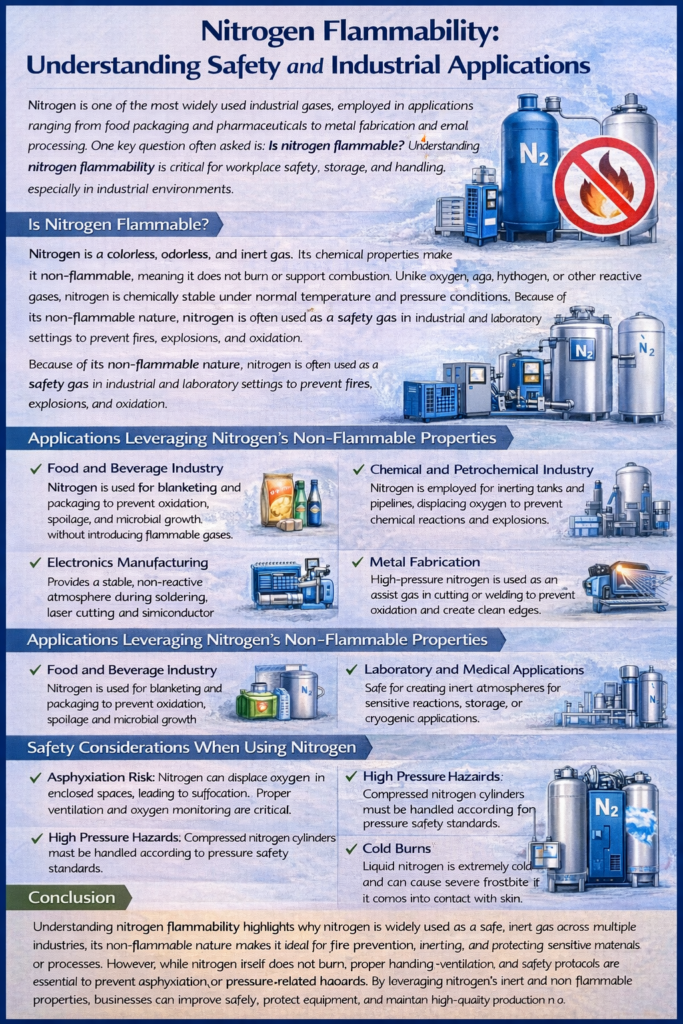
Is Nitrogen Flammable?
Nitrogen is a colorless, odorless, and inert gas. Its chemical properties make it non-flammable, meaning it does not burn or support combustion. Unlike oxygen, hydrogen, or other reactive gases, nitrogen is chemically stable under normal temperature and pressure conditions.
Because of its non-flammable nature, nitrogen is often used as a safety gas in industrial and laboratory settings to prevent fires, explosions, and oxidation.
Why Nitrogen Is Considered Safe
Inert Nature: Nitrogen does not react with other chemicals under standard conditions.
Does Not Support Combustion: It cannot ignite or sustain a flame.
Used for Fire Prevention: Nitrogen can replace oxygen in storage tanks, pipelines, or confined spaces, reducing fire and explosion risks.
Applications Leveraging Nitrogen’s Non-Flammable Properties
Food and Beverage Industry
Nitrogen is used for blanketing and packaging to prevent oxidation, spoilage, and microbial growth without introducing flammable gases.Chemical and Petrochemical Industry
Nitrogen is employed for inerting tanks and pipelines, displacing oxygen to prevent chemical reactions and explosions.Electronics Manufacturing
Provides a stable, non-reactive atmosphere during soldering, laser cutting, and semiconductor production.Metal Fabrication
High-pressure nitrogen is used as an assist gas in cutting or welding to prevent oxidation and create clean edges.Laboratory and Medical Applications
Safe for creating inert atmospheres for sensitive reactions, storage, or cryogenic applications.
Safety Considerations When Using Nitrogen
While nitrogen is non-flammable, it can still pose safety risks if not handled properly:
Asphyxiation Risk: Nitrogen can displace oxygen in enclosed spaces, leading to suffocation. Proper ventilation and oxygen monitoring are critical.
High Pressure Hazards: Compressed nitrogen cylinders must be handled according to pressure safety standards.
Cold Burns: Liquid nitrogen is extremely cold and can cause severe frostbite if it comes into contact with skin.
Conclusion
Understanding nitrogen flammability highlights why nitrogen is widely used as a safe, inert gas across multiple industries. Its non-flammable nature makes it ideal for fire prevention, inerting, and protecting sensitive materials or processes. However, while nitrogen itself does not burn, proper handling, ventilation, and safety protocols are essential to prevent asphyxiation or pressure-related hazards.
By leveraging nitrogen’s inert and non-flammable properties, businesses can improve safety, protect equipment, and maintain high-quality production in a variety of industrial applications.